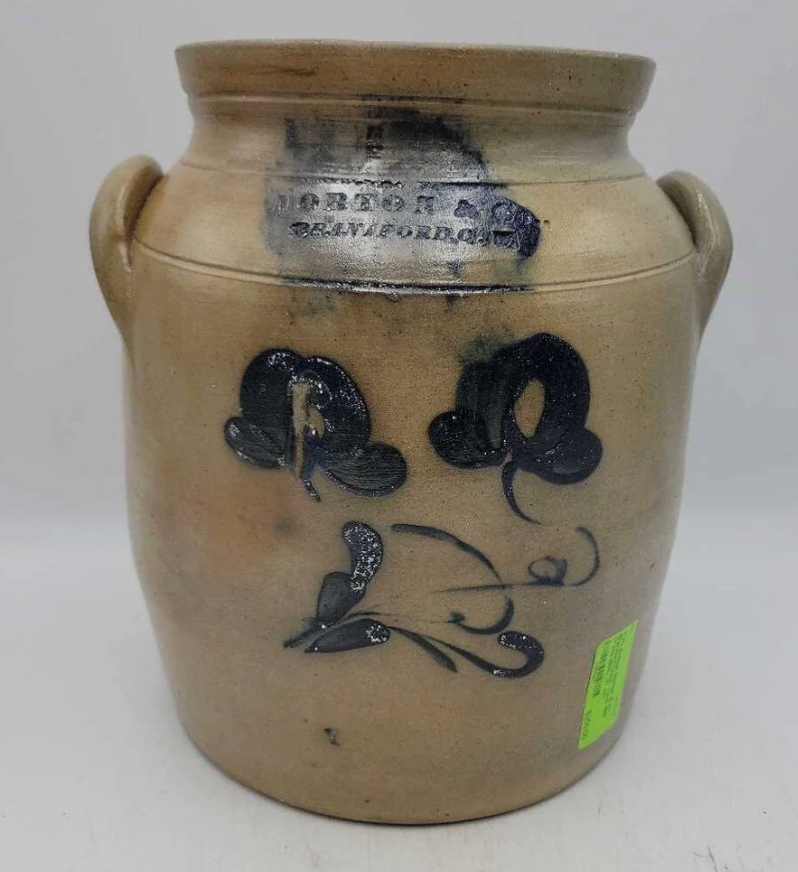

Antique pottery tells the story of everyday life in a way few other objects can — rugged, functional, yet full of character. Among these, merchant jugs from the 19th century are especially fascinating: utilitarian vessels that once carried liquids like cider, vinegar, spirits, or molasses, and now connect us to the people and commercial practices of early Canada.
One such piece is the 19th-Century Merchant Jug — 2 Gallon Eustache Quebec now available at Waterford Antique Market. This substantial stoneware jug reflects not just the craftsmanship of its maker, but also the ways in which ceramics were woven into daily life and commerce in Quebec during the 1800s.
What Is a Merchant Jug?
In the 1800s, before modern packaging and distribution systems, merchants and householders relied on durable stoneware jugs to store and transport liquids. Often made from local clays and salt-glazed for strength, these jugs were utilitarian by design but could also be decorated or marked with the maker’s or merchant’s region.
Jugs like the Eustache example measured capacity in gallons — in this case, two gallons — and were typically used to hold products such as:
-
Cider or vinegar
-
Spirits or liquor
-
Molasses or syrup
-
Oils and household liquids
Their robust forms and strong handles made them practical for frequent use, while their construction ensured they survived transport and everyday wear.
Quebec Stoneware Traditions
Quebec has a rich history of pottery and stoneware production that dates back to early French settlement in North America. Potters in Quebec worked with locally sourced clays and adapted European techniques — including salt glazing and cobalt decoration — to produce stoneware that could withstand both domestic use and the rugged demands of shipping and tavern trade.
Merchant jugs were especially common in regions with active trade because stores and taverns would refill them for customers. Over time, many such jugs were simply repurposed or reused, which makes surviving examples today increasingly rare and valuable to collectors.
Why Collectors Love 19th-Century Merchant Jugs
For collectors of antique pottery, merchant jugs like this one are prized for several reasons:
-
Local character: Unlike mass-produced ceramics from later periods, these jugs were often made by regional potters using local materials.
-
Functional history: They reflect everyday life and commerce in 19th-century Canada.
-
Aesthetic appeal: Even utilitarian jugs often show variation in form, glaze, and clay texture that make each piece unique.
-
Rarity: Intact stoneware from this period, especially in larger sizes like a two-gallon jug, is uncommon.
Whether displayed in a kitchen, study, or collector’s shelf, a piece like this connects the past to the present, capturing both function and tradition in a single artifact.
About This Quebec Merchant Jug
The 19th-Century Merchant Jug — 2 Gallon Eustache Quebec (DS) presents a wonderful example of Canadian stoneware. Its substantial capacity and classic form make it both a statement piece and a reminder of how everyday objects were once essential tools of daily life.
Because each jug from this era was made by hand and fired in small batches, no two are exactly alike — and once a piece is gone, it’s gone.