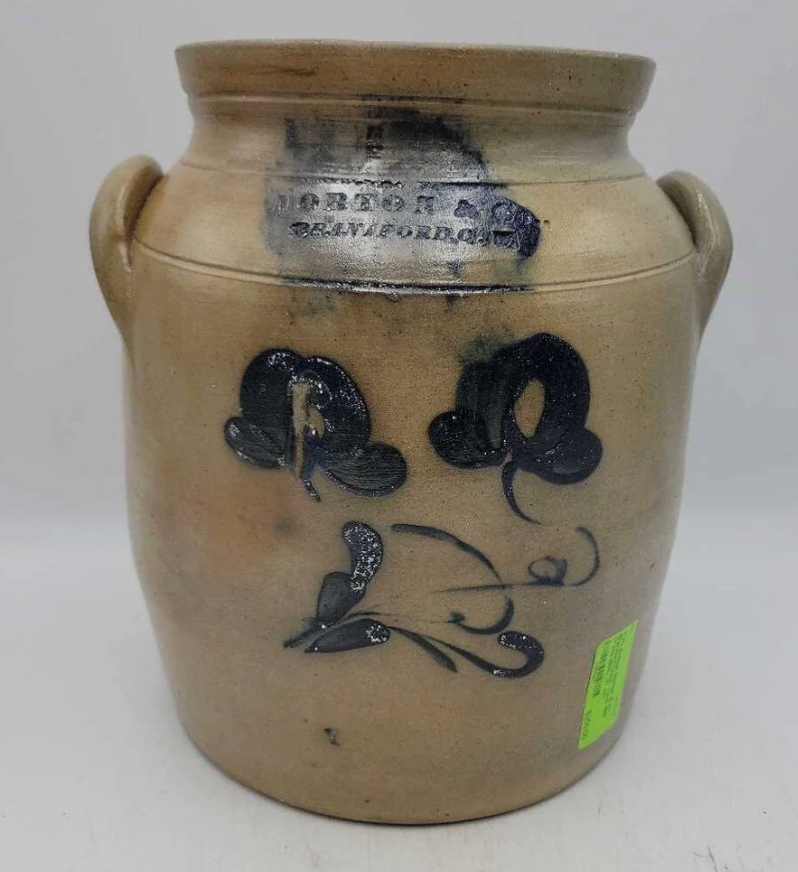
Every once in a while, a piece comes along that feels a little different. Not just old—but anchored in a specific moment in time. This Morton & Co., Brantford crock from around 1867 is exactly that kind of piece.
It’s not just an antique. It’s something that would have been used right here in the early days of Brantford, when the town was still growing into the industrial centre it would eventually become. You can almost picture it sitting in a general store or tucked into a family kitchen, holding butter, preserves, or dry goods—doing the quiet, everyday work of life in the 1800s.
The mystery of Morton & Co.
What makes this crock even more interesting is the name stamped into it: Morton & Co.
There’s no long corporate history here. No big archives or widely documented legacy. And that’s actually part of the appeal.
Businesses like this were often small, local operations. They served their communities, and when they closed, they disappeared—sometimes leaving behind only pieces like this as evidence they ever existed. That stamp on the crock isn’t just branding—it’s one of the only surviving traces of a business that was once part of Brantford’s early economy.
That kind of mystery adds a layer of intrigue collectors really value. It turns the piece into more than an object—it becomes a bit of a historical puzzle.
Why 1867 matters
The date tied to this crock isn’t random—it lines up with Canadian Confederation, the year Canada officially became a country.
That alone puts this piece in a very small category. You’re looking at something that existed right at the beginning of modern Canada. It’s easy to say “antique,” but this is early Canada antique—and that’s a different level entirely.
There’s something powerful about that. This crock was around when the country itself was just getting started.
The craftsmanship you don’t see anymore

If you look closely at pieces like this, you start to notice the details that make them special. The salt-glazed finish, the soft variations in the surface, the cobalt blue decoration—none of it is perfectly uniform, and that’s exactly the point.
 This wasn’t mass production. It was made by hand, fired in a kiln, and built to last. Every small imperfection tells you it was created in a time when function came first, but craftsmanship still mattered.
And unlike modern decor pieces trying to imitate this look, this one doesn’t need to pretend. It’s the real thing.
What makes this crock so rare
What really sets this piece apart is how many things had to line up for it to still exist today.
It comes from a small, likely short-lived company. It’s clearly marked with its origin—Brantford—which collectors love. It dates to a period where far fewer items survived, simply because they were used hard and often.
And then there’s the fact that it made it through over 150 years without being lost, broken, or discarded.
That’s not common.
Most crocks from this era were everyday workhorses. They weren’t saved or protected—they were used until they weren’t usable anymore. So when one surfaces with a clear maker’s mark and a strong connection to a place and time, it stands out immediately.
The investment side of a piece like this
From an investment perspective, pieces like this tend to follow a very specific pattern.
There’s a fixed number of them in the world, and that number only goes down over time. At the same time, interest in early Canadian antiques—especially pieces with strong regional ties—has been steadily growing.
This crock checks a lot of boxes collectors look for. It has age, a defined location, a maker’s mark, and a story that’s easy to understand and appreciate.
It’s also incredibly easy to live with. Whether it’s styled in a home, used in a retail display, or part of a collection, it naturally draws attention. And that matters, because pieces that people connect with visually and emotionally tend to hold their value—and often increase over time.
More than just an antique
At the end of the day, what makes this crock special isn’t just rarity or investment potential.
It’s the connection.
It’s knowing that this piece existed in Brantford at a time when everything was just starting to take shape. That it was part of daily life. That it served a purpose long before it became collectible.
Now, it’s something entirely different.
It’s history you can display.
It’s a conversation starter.
And for the right buyer, it’s one of those pieces you don’t come across twice.

